

Workshop date: 3 August 2026 (and further days)
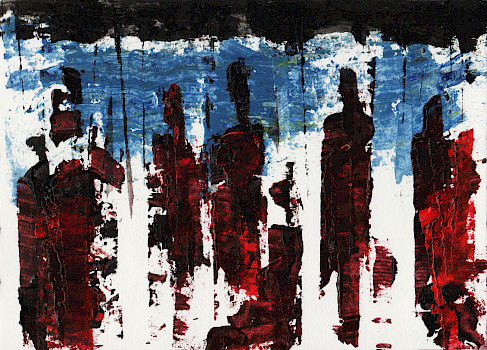
Sandipan Das, Abstraction. Acrylic on paper, 2026
Announcement and Call for Papers
The first workshop of the project “Constructing the Heritage Archive of Orature in Non-Scripted Languages”, part of the collaboration between the AILC-ICLA and the UNESCO Memory of the World Programme, aims at examining the theoretical and ethical framework of this research, promoting methodological shifts in research and pedagogy that facilitate inclusion and ethical practice, and producing practical tools that can sustain future research.
The more than 1000 mother-tongues identified by the People’s Linguistic Survey of India (reports published by Orient Blackswan) show how broad the spectrum can be of relationships between script and orality in various configurations across geographies and encourage us to focus this first workshop on examples from India, while inviting experts of non-scripted languages in other parts of the world to respond and comment to broaden and nuance our perspectives.
The workshop will take into account and reflect on the theoretical parameters of the project and will include the following aims and objectives:
A) Methodological Shifts and Ethical Representation
1. To seek ways of facilitating technological access and ability to use the contemporary condition of virtual-real complementarity in order to “neutralise” systemic discrimination.
2. To develop protocols that integrate into pedagogical practice – both in teaching modules and research training – an active reflection on:
i) the ethics and economy of documentation in oral and in hybrid situations;
ii) the relation of researcher to the performativity of the oral expression;
iii) the relation of researcher to the text and medium in the construction of a digital document;
iv) the collaborative complementary of intermedial documentation.
B) Tangible Outcomes
3. Help connecting researchers and well as practitioners working in performance and non-script fields so that a common modus operandi for making, assessing, and using digital resources can evolve, taking the multiplicity and diversity of experiences into account.
4. Start developing resources that can support the further work of scholars in the field, including a collaborative document/digital handbook; individual papers and/or audio-visual essays/soundscapes.
The workshop therefore proposes itself as a methodological laboratory to lay a geocultural and theoretical framework for digital documentation and preservation of performative forms in non-scripted languages.
Presentations will address the distinct ways of thinking about oral composition, transmission and documentation in non-script societies. They will highlight best practice (including any recommended changes to current practices) in pedagogy, research design, recording, documenting and archiving.
The workshop is expected to take place over 2 or 3 sessions of c. 3 hours each, held on successive days and each consisting of presentations of c. 30 minutes + discussion. The sessions will include the playing of audio-visual excerpts (each from different regions) to reflect collectively on how ethics, framing, and virtuality operate in practice.
Proposals are invited for 30-minute presentations and discussions of audio/visual documentation of oral performative forms, which should also seek to reflect on the following issues:
1. Is the intellectual and philosophical orientation for orality and performance research distinct from that which concerns scripted documentation?
2. How? (Methods and issues you have faced in collection / documentation / conceptualising “beyond script”.)
3. The “ethics” of remembering and (mis)representation: What ethical issues did you identify as arising from 1 and 2, and how did you (or do you propose to) deal with them?
Proposals of up to 500 words should be submitted by 1 June 2026, using the form at: https://forms.gle/mLpfaFN2dRsay9VE6. Proposals should address the three questions above, and include a description of the audio/visual material to be submitted and shared. They should also be accompanied by 5-8 keywords, a short biography of the presenter (no more than 120 words), and evidence of consent obtained from individuals whose words, voices and performances have been recorded.
Contributions in South Asian languages other than English are welcome if accompanied by a (co-)presentation in English (as lingua franca), in order to ensure ability to share insights.
If a proposal is accepted, the relevant audio/visual resources should be submitted by 22 June 2026. Note that permission / consent must have been obtained in order for the material to be shared with the workshop participants. Proposals not accompanied by evidence of consent will not be accepted.
The workshop will take place in the week starting 3 August 2026 (the exact number of sessions will be confirmed once submissions have been received).
The Workshop is organised by Ipshita Chanda, Suchetana Banerjee and Lucia Boldrini, and will be hosted by the Centre for Comparative Literature, Goldsmiths, University of London.
For any questions, please contact Dr Suchetana Banerjee at [email protected].
The ICLA/MoW Series is coordinated jointly by Professor Lucia Boldrini (Honorary President, AILC-ICLA, and CCL Honorary Director), Professor Ipshita Chanda (AILC-ICLA President, 2025-28) and Professor Lothar Jordan (Chair of the MoW Sub-Committee for Education and Research, SCEaR).